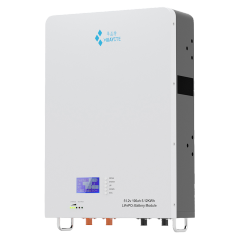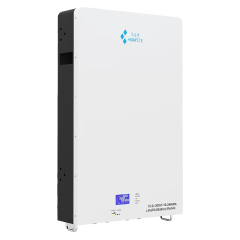
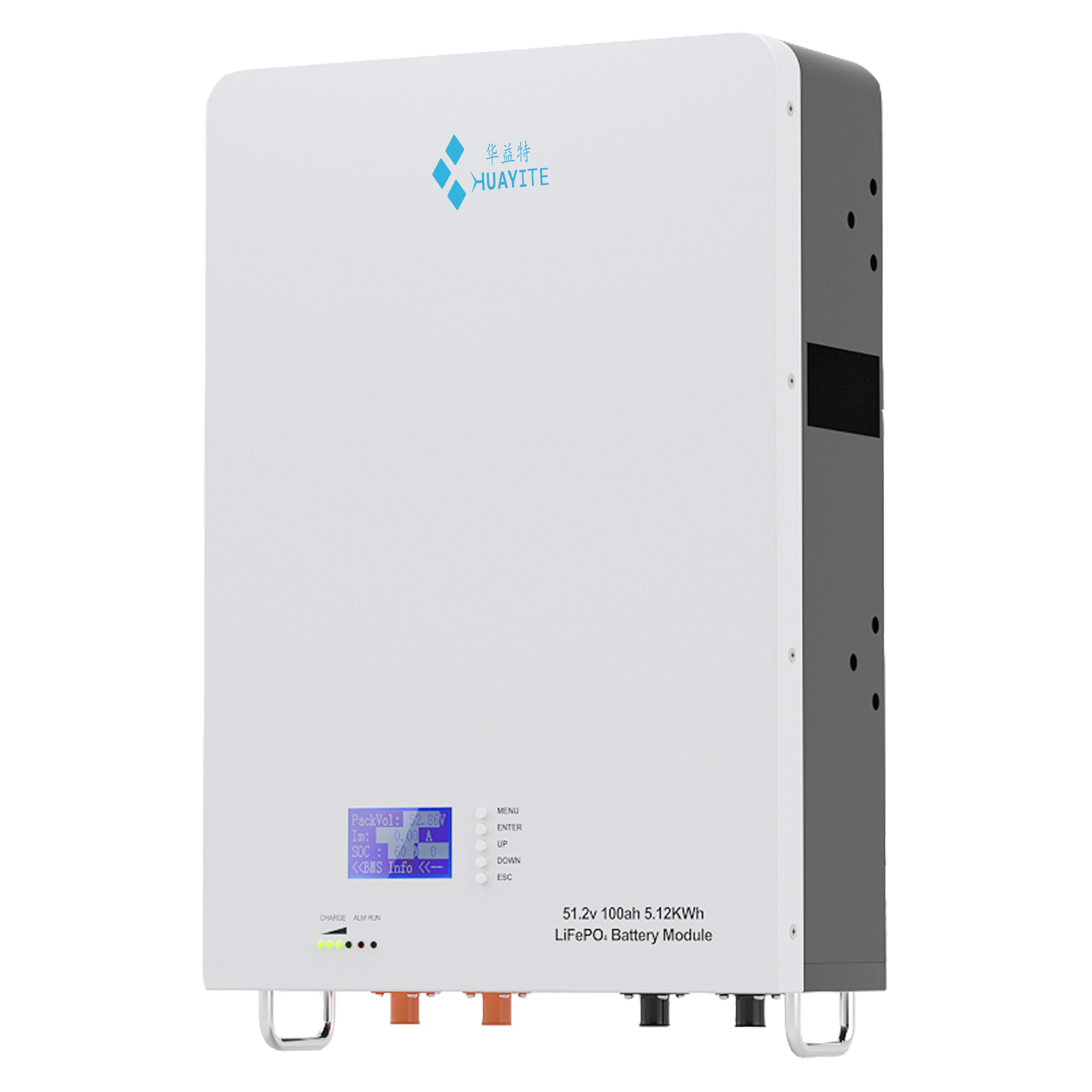
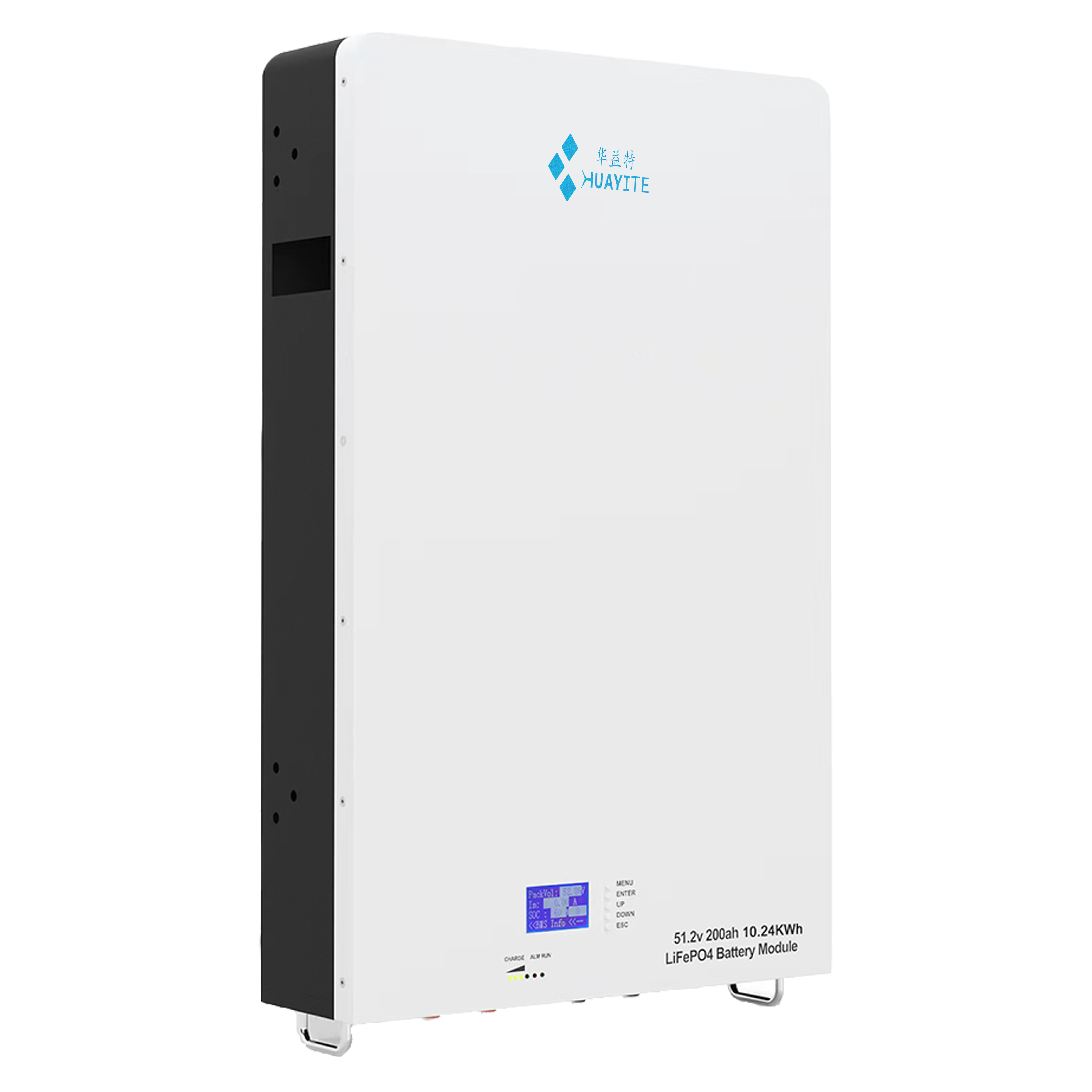

 Robust &Modern DesignClear System Display:LCD+LEDIndustry-Leading Longevity:6000+cyclesAdvanced Remote Management(Optional):CAN/RS232/RS485Integrated WiFi BMS with LCD for real-time monitoring and controlIdeal Applications:Optimized for residential solar,mobile power stations etc
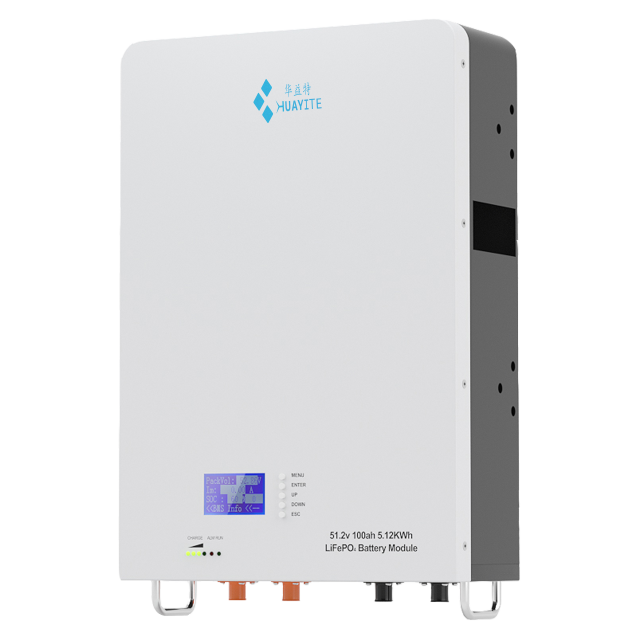
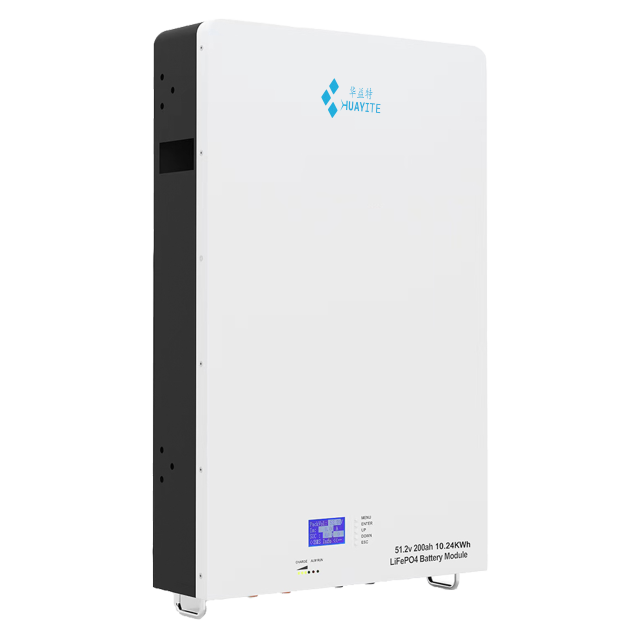
A lithium iron phosphate pack designed to hang where the inverter already lives. The series comes in two ratings — 5.12 kWh and 10.24 kWh — both at 51.2 V nominal, and both assembled from matched 3.2 V cells in series with a battery management system on board.
The front panel does most of the day-to-day talking: state of charge, pack voltage and current on the main screen, a BMS information page holding the detail a technician needs, and three lights that say whether the pack is running, charging or unhappy. Five buttons below the screen walk through the menus, so a site visit does not depend on somebody bringing a laptop.
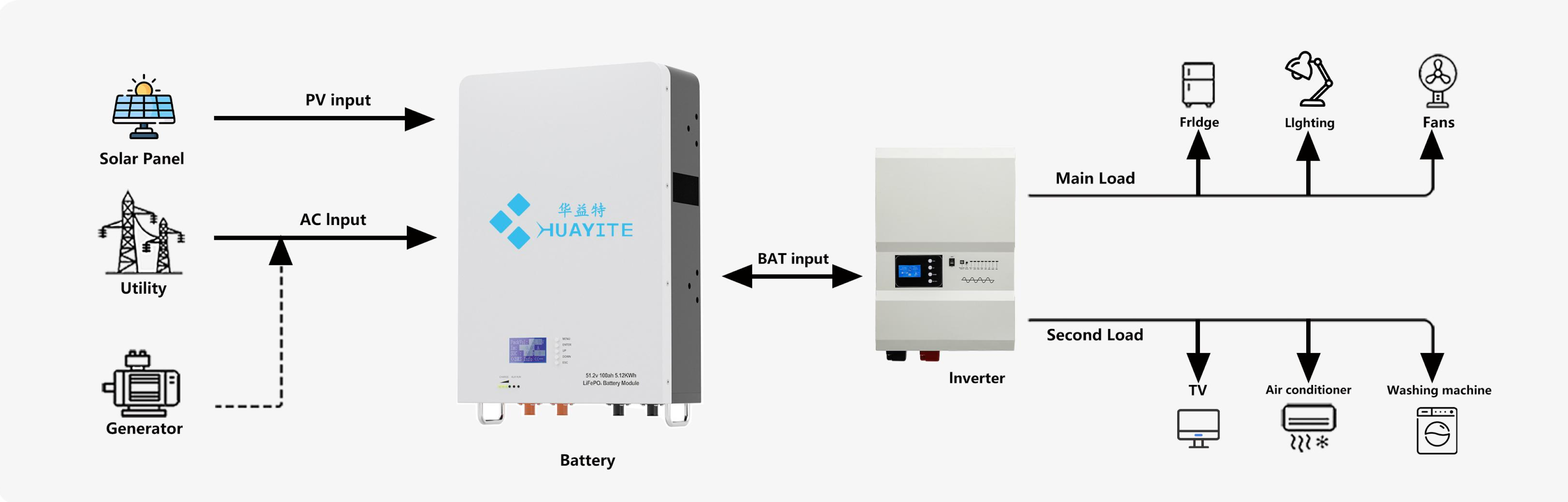
Most projects slot this unit into a solar battery storage system that is already being built around a hybrid inverter. The pack supplies the storage, the inverter supplies the conversion, and the two exchange data over CAN, RS485 or RS232 once the optional protocol card is fitted. Keeping those roles separate means an inverter can be changed later without touching the battery.
As a solar battery manufacturer we ship the pack as a documented component rather than a bare cell stack — nameplate data, terminal details, protocol options and the system drawing all travel with the consignment. Distributors stock both ratings side by side; integrators fit the smaller pack to a backup circuit and the larger one where a single wall position has to carry a whole evening's load; caravan and mobile power builders use the same case because the format travels as well as it hangs. The wall-mounted LiFePO4 battery design supports streamlined installation and space-efficient layouts. A WiFi BMS with optional communication protocols gives system integrators and OEM/ODM buyers practical control, while modular capacity options allow flexible order sizing for wholesale procurement.
The case is a standard plastic enclosure, closed on all sides, with ventilation slots down both flanks and the DC terminals recessed into the underside. A steel bracket carries the pack's weight and is fixed first, so the heavy part of the job is done with both hands free and nothing is held in mid-air.
Inside, the cells sit in series on a compression frame, busbar-linked and monitored by a BMS board. The two ratings differ only in cell capacity — 100 Ah cells in the 5.12 kWh unit, 200 Ah cells in the 10.24 kWh unit — which is why the terminal layout, the menu structure and the protocol options stay identical whether a project uses one pack or four.
The enclosure is built for indoor, dry locations: plant rooms, service cupboards, garages and vehicle bays. It is not a marine or outdoor housing, and it should not be washed down. Leave the terminals reachable and keep the case clear of standing water or anything that could fall against it.
Depth matters more than width on a wall. This is a wall mounted LiFePO4 battery with a shallow case, so it hangs inside the footprint of an ordinary cupboard instead of projecting into a corridor — usually the constraint that decides where a LiFePO4 solar battery can actually go in a retrofit. Residential solar setups can use it for reliable battery backup and self-consumption management, with integrated monitoring helping end users and installers track battery status. Scalable capacities and safety features are intended for maintenance-sensitive environments and project customization. In mobile power stations, off-grid cabins, and remote sites, it is built as durable storage for varying environmental conditions; OEM and project buyers can source it for small commercial or travel applications where consistent performance and remote management options matter.
| Model | HET-W5000 | HET-W10000 |
|---|---|---|
| Nominal voltage | 51.2 V | 51.2 V |
| Nominal capacity | 100 Ah (C5, 25 °C) | 200 Ah (C5, 25 °C) |
| Energy | 5.12 kWh | 10.24 kWh |
| Internal resistance | ≤ 50 mΩ | ≤ 50 mΩ |
| Cycle life | >3000 cycles | > 3000 cycles |
| Charge efficiency | 100% @ 0.2C | 100% @ 0.2C |
| Discharge efficiency | 96–99% @ 1C | 96–99% @ 1C |
| Charge voltage / cut-off | 58.4 ± 0.2 V / 58.4 V | 58.4 ± 0.2 V / 58.4 V |
| Charge mode | 0.2C to 58.4V,then 58.4,charge current 0.02C(CC/CV) | 0.2C to 58.4 V, then 58.4 V at 0.02C (CC/CV) |
| Charger current | 25 A | 50 A |
| Max. charge current | 50 A | 75 A |
| Continuous discharge current | 100 A | 100 A |
| Max. pulse current | 150 A | 200 A |
| Discharge cut-off voltage | 40V | 40 V |
| Months self-discharge | <3% | <3% |
| Charge temperature | 0°C to 45°C (32°F to 113°F) @ 60±25% RH | 0°C to 45°C (32°F to 113°F) @ 60±25% RH |
| Discharge temperature | -20°C to 60°C (-4°F to 140°F) @ 60±25% RH | -20°C to 60°C (-4°F to 140°F) @ 60±25% RH |
| Storage temperature | 0°C to 40°C (32°F to 104°F) @ 60±25% RH | 0°C to 40°C (32°F to 104°F) @ 60±25% RH |
| Water & dust resistance | IP20 | IP20 |
| Cell configuration | 3.2 V 100 Ah, 16S | 3.2 V 200 Ah, 16S |
| BMS | 16S 100 A | 16S 100 A |
| Plastic case | Standard plastic case | Standard plastic case |
| Dimensions (W × H × D) | 570 × 360 × 140 mm | 860 × 540 × 140 mm |
| Weight | 47 kg | 90 kg |
| Terminal | Energy storage connector | Energy storage connector |
| Protocol (optional) | RS485 / CAN | RS485 / CAN |
 No watering, no equalisation charge. The lead-acid routine of topping up cells, checking electrolyte and ventilating an acid room disappears completely. What is left is inspection and record-keeping, which is why a LiFePO4 solar battery suits sites that are visited twice a year rather than weekly.
What the battery-side cover runs to. Read the battery terms on their own, separately from the rest of the system: the BMS and electronics on one hand, the cells on the other. Ask your sales contact for the written statement that applies to your order — what is covered, what is excluded, how a claim has to be evidenced — and keep that document in the site file next to the commissioning sheet. A retention question can only be settled with records — the charge and discharge settings, the average temperature at the wall, how deeply the pack is cycled each night and the BMS cycle count. Ask for the retention figure your warranty is written against rather than assuming it is 100%. Where claims usually come apart. Water into an IP20 case, charging below 0 °C, a charge voltage above the published 58.4 V limit, an older pack mixed into a new LiFePO4 battery bank, or a case that has been opened — these are the conditions the specification already rules out, and the ones to check against the exclusion list before you commit, especially on an OEM project where the charge profile is set by somebody else. Handling a claim quickly. Serial number, commissioning date, the settings recorded at handover, the BMS event history and photographs of the installation. A distributor who holds those can answer a customer's complaint without shipping a pack back first; a claim that arrives with only a description takes far longer to settle.
Choosing between 5.12 kWh and 10.24 kWh is mostly a question of what has to keep running, and for how long, after the sun goes down. The smaller pack covers a lighting and communications circuit — router, fridge, a few LED fittings, phone chargers — through an evening and the night that follows. The larger pack is the one that carries a household's real evening load, or a shop counter with a display fridge and a till.
Size from the load rather than from the price list. Add up the continuous watts you want to hold through the longest outage you plan for, multiply by the hours, then add headroom for inverter losses, cold-weather capacity loss and the fact that nobody wants to run a pack down to its discharge cut-off every night. If the answer lands between the two ratings, two 5.12 kWh packs often beat one 10.24 kWh pack on logistics — but they need two wall positions and two sets of DC protection.
When you build a LiFePO4 battery bank from more than one pack, keep the ratings identical and the ages close. Mixed capacities in one bank pull the smaller pack towards its limits first, and a pack added two years later will not share current evenly with its older neighbours. If expansion is likely, say so at the quoting stage; planning wall space and protection once is easier than retrofitting it.
Both ratings share the same terminal layout, the same protocol options and the same commissioning steps, which is what most distributors are buying when they standardise on one series. Fewer variants on the shelf means one commissioning procedure, one training session and one set of assumptions behind every solar battery storage solutions quote their sales team sends out.
Share your load profile, battery voltage and backup requirement, and our engineers will help you match a model from our full range and confirm the accessories that go with it. The same Shenzhen-based team, with in-house R&D and more than 20 years in the industry behind them, stays with you after delivery: wiring and commissioning guidance, fault diagnosis, and spare-part support for units already in service. For private-label projects, they also handle artwork and specification approvals before production. Consistency starts with the cells. Each string is built from matched cells rather than a random draw from the bin, the BMS is configured to that specific string, and every screen, button and communication port is function-checked before the case is closed. Both ratings come off the same line to the same routine, which is what a solar battery manufacturer owes a distributor who reorders: the fourth shipment has to commission exactly like the first, with the same menu, the same alarm codes and the same behaviour on the wall. Final checks cover the parts a buyer actually touches. The display is powered up and read, the terminals are inspected and capped, the mounting bracket is test-fitted, and the case is checked for vents and fixings. A LiFePO4 solar battery that arrives with a loose terminal cover costs an installation day; one that arrives right costs nothing. Documentation travels with the consignment — nameplate data, terminal and protocol details, and handling notes for a pack in this weight class. Projects that file a technical submittal usually want the datasheet and the system drawing behind their solar battery storage solutions proposal; both are available, and bundling them at the order stage is simpler than chasing them afterwards.
Yes. A second pack on the same bank adds capacity without changing the inverter or the wiring layout, provided both packs carry the same rating and are close in age. Plan the second wall position and its DC protection now, because retrofitting a breaker and a bracket into a finished plant room is the slow part of the job. Confirm your inverter's maximum battery capacity before you go beyond two.
The BMS opens the charge path at 58.4 V and closes the discharge path at 40 V. Between those limits it balances the cells, caps the current and watches temperature. If a limit is reached the ALM light comes on and the screen shows which protection tripped, which is the first thing to read before assuming the inverter is at fault.
A load-bearing masonry wall, or a frame designed for the weight of a wall mounted LiFePO4 battery with the pack full. Lightweight studwork needs a reinforced position or a support designed by your engineer. Put the bracket where the screen lands at eye level and leave working room below for the DC cable bend.
The published figure for this series is more than 3,000 full charge–discharge cycles, and the same series is quoted at 6,000+ cycles where depth of discharge and temperature stay favourable. In practice, heat, sustained high charge current and long periods sitting at a low state of charge are what shorten life, so a ventilated position and a sensible depth of discharge matter more than any single number. If you are planning against a specific figure, ask for the test conditions behind it.
Very little beyond looking at it. Check the screen and the ALM light on a routine walk-round, keep the side slots and the terminals clear, and make sure nothing has been stacked against the case. There is no watering, no equalisation charge and no electrolyte to top up. A pack left idle for months is better stored part-charged than flat.
Discharge is rated down to -20 °C, but charging is rated from 0 °C upward. A pack in an unheated outbuilding therefore needs its charge window planned around the weather rather than around the sun, or the pack moved somewhere that stays above freezing.
Only if that inverter lets you set custom voltages. A fixed lead-acid or gel profile will either undercharge the pack or push it into protection, so set the charge voltage, charge current and discharge cut-off to the published values if the menu allows it. If there is no custom option, pair the pack with a hybrid inverter that has a lithium profile instead of compromising on the settings.
Robust &Modern Design.Clear System Display:LCD+LED.Industry-Leading Longevity:6000+cycles.Advanced Remote Management(Optional):CAN/RS232/RS485.Integrated WiFi BMS with LCD for real-time monitoring and control.Ideal Applications:Optimized for residential solar,mobile power stations etc.